

Climate and Food Systems Work Group
The food system plays a major role in our climate as a huge source of greenhouse gas emissions. It’s also an industry that's deeply vulnerable to climate change, yet presents a unique opportunity for climate mitigation & resilience. At the 2023 Convergence, there was an expressed need to organize so that climate becomes inextricably woven into the fabric of our food system policies, investments, and on-the-ground actions.
The first step towards this shift is to build relationships among those who are taking action in food & climate efforts. We formed the Climate & Food Systems Work Group to build those relationships and explore where we can leverage the most change and prepare to take collective action.
Contact: Juliana at juliana.beecher@gmail.com to join!
Meetings are generally on the First Thursday of the Month from 11M-12PM
Current Projects
Our current focus is on wasted food, which poses environmental, social, and economic challenges and opportunities across the food system. It’s also an issue that anyone can engage with, because we all eat food!
In spring 2026, the Climate & Food Systems Work Group hosted a series of community listening sessions on the topic of wasted food. These sessions were pilots for grassroots initiatives for local conversation, engagement, and action around the state.
Tips & Resources to Reduce Wasted Food & Recycle Food Scraps
In the Kitchen
Plan your meals before shopping.
Make a shopping list.
…and stick to it! Avoiding impulse buying can save money and ensure you have a plan for what you buy.
Shop your fridge first.
What do you already have? What needs to be used up this week? What ingredient on your shopping list can you substitute with something you already have?
Store food to make it last.
Use your freezer!
Label foods to “Eat me first!” and place prominently!
Make best use of items that are past their prime or often tossed.
Recipes for past-prime, scraps, and zero waste from Save the Food
Reference Eat or Toss to understand what’s going on with that funky-looking food (hint: it might still be perfectly good to eat!)
Make broth with veggie scraps! Recipe for Vegetable Broth
Prepare the right amount, serve smaller portions (come back for seconds!), and have a plan for leftovers.
Throwing a party? Use the Guestimator Tool to figure out how much food you need.
Fridge Feast Fridays, Waste Less Wednesdays…
Designate a night to eat leftovers and use those ingredients that have been lingering.
Community
Track wasted food at home as a community.
Advocate for municipal action on wasted food.
Restaurants & Food Businesses
Donate surplus! Federal liability protection for food donation is very robust & the Food Code supports food donation
Repurpose with a Purpose - Report & Guide from Menus for Change
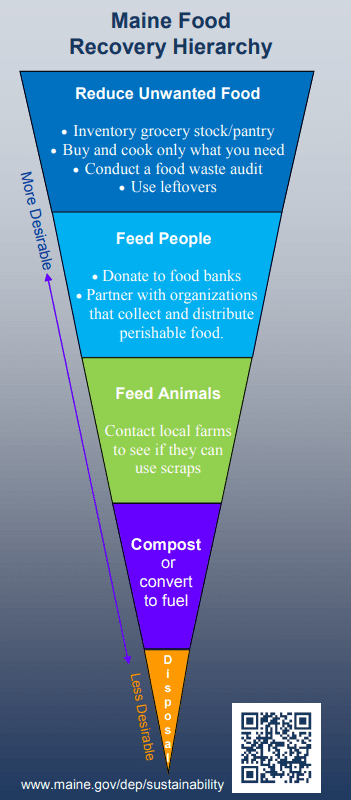
Divert scraps from the trash to composting - see list of Maine composters below.
Schools & Institutions
Maine School Cafeteria “No More Wasted Food” DIY Toolkit from Food Rescue MAINE
Repurpose with a Purpose Report & Guide from Menus for Change
Divert scraps from the trash to composting - see list of Maine composters below or start a compost project onsite.
Did you know?
In the U.S., an average household of four spends almost $3000 each year on food that’s never eaten.
Did you know?
Date labels are indicators of quality not safety. Manufacturers are not required to put date labels on foods. The only exception is infant formula.
“Best by”, “Use by”, “Best before”, “Sell by” - all indicate when the manufacturer thinks food tastes best. These labels and dates are not standardized, and how they are chosen varies by manufacturer and state.
Shelf-stable foods often have expiration dates, even though they stay good for years past those dates.
Did you know?
Maine has the longest-running compost school in the U.S. Check out the Maine Compost School!
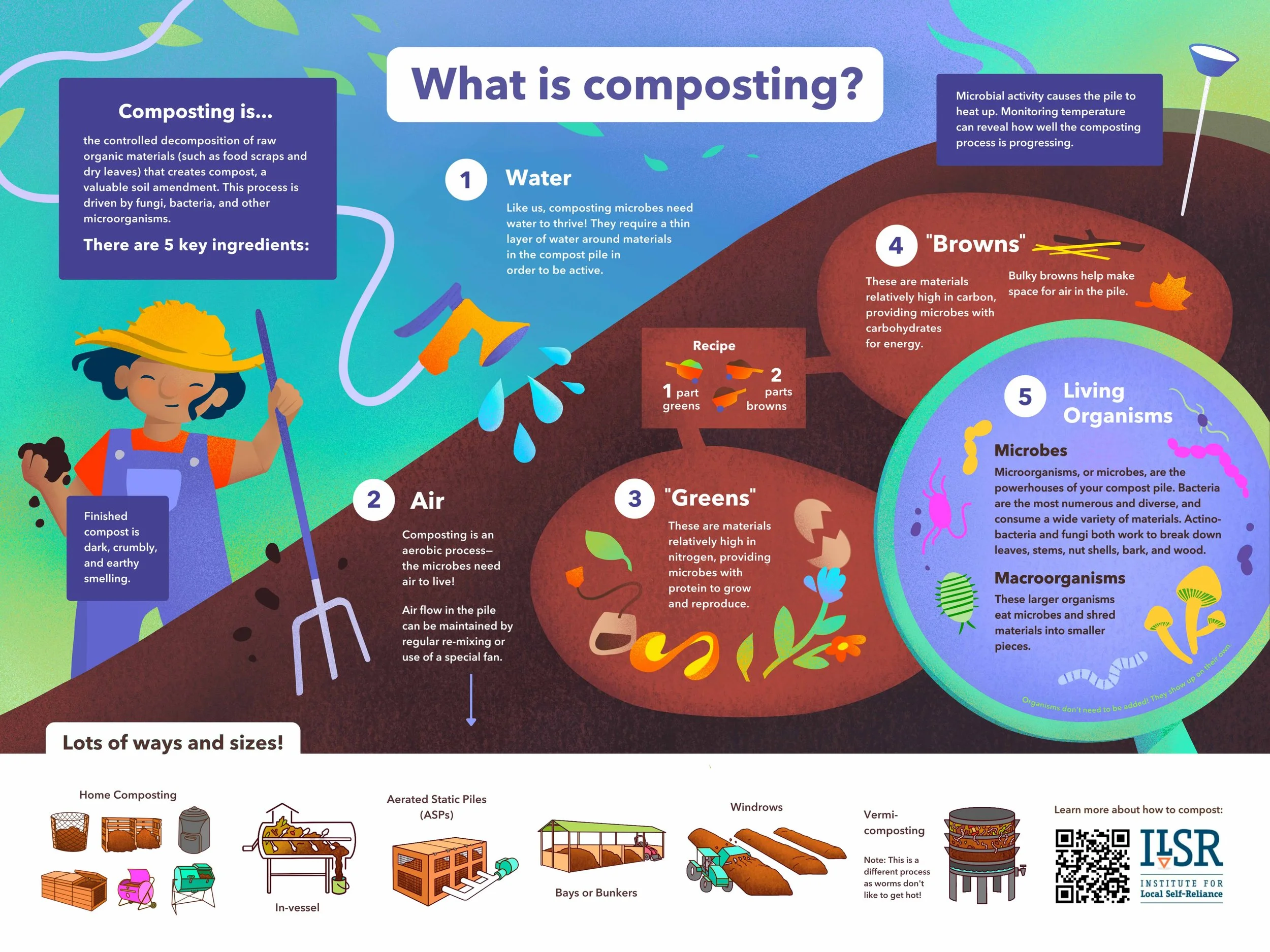
Home composting:
Home Composting 101: A Guide to Backyard Hot Composting from the Institute for Local Self-Reliance (ILSR)
Home Composting Bulletin from University of Maine Cooperative Extension
Community Composting:
How to start a community composting projectby Brenda Platt from ILSR
Grant to support the development of a school composting program from EcoMaine
Keep Compost Local: A Roadmap for Local Governments to Build Community Prosperity with Composting from ILSR
Maine Composters & Haulers:
More and more parts of the state are served by local composting companies and/or have community drop-off kiosks for food scraps.
1 Earth Composting- Commercial & Residential - Bangor area
Chickadee Compost - Commercial & Residential - Ellsworth, Blue Hill Peninsula, Deer Isle
Diggers Cooperative - Commercial - Southern ME
Garbage to Garden - Commercial & Residential - Greater Portland area to Bath
Maine Compost Co - Commercial & Residential - Androscoggin Co & beyond
Mr. Fox Composting - Commercial & Residential - York Co & Seacoast, NH
ScrapDogs - Commercial & Residential - Midcoast, Belfast to Thomaston
Looking for more?
Check out these resource libraries!
Language matters!
Why do we say “wasted food” instead of “food waste”?
Because food is never waste, never trash, never garbage - not until it is wasted and can no longer be eaten. Even then, it’s a valuable resource, full of carbon and nutrients that can be returned to the soil, supporting the growth of more food.
Some of the graphics on this page come from the Institute for Local Self-Reliance (www.ilsr.org), a national nonprofit organization working to strengthen local economies, and redirect waste into local recycling, composting, and reuse industries. They are reprinted here with permission. Find more compost-related resources and graphics at ilsr.org/composting.
Convergence Work Groups
Workgroups are cross-sector collaborative projects that advance priorities identified by the Convergence network and which have energy to move them forward. They are organized to leverage resources and work proactively on complex issues impacting food access, climate change mitigation and shifting power in Maine’s food system to center BIPoC, youth, and others with lived experience of our system’s inequities.